
2025 was a challenging year for scientists in the US. Researchers have faced uncertainty across funding, job security, trade, onshoring, and education. These changes ripple through every part of the research landscape.
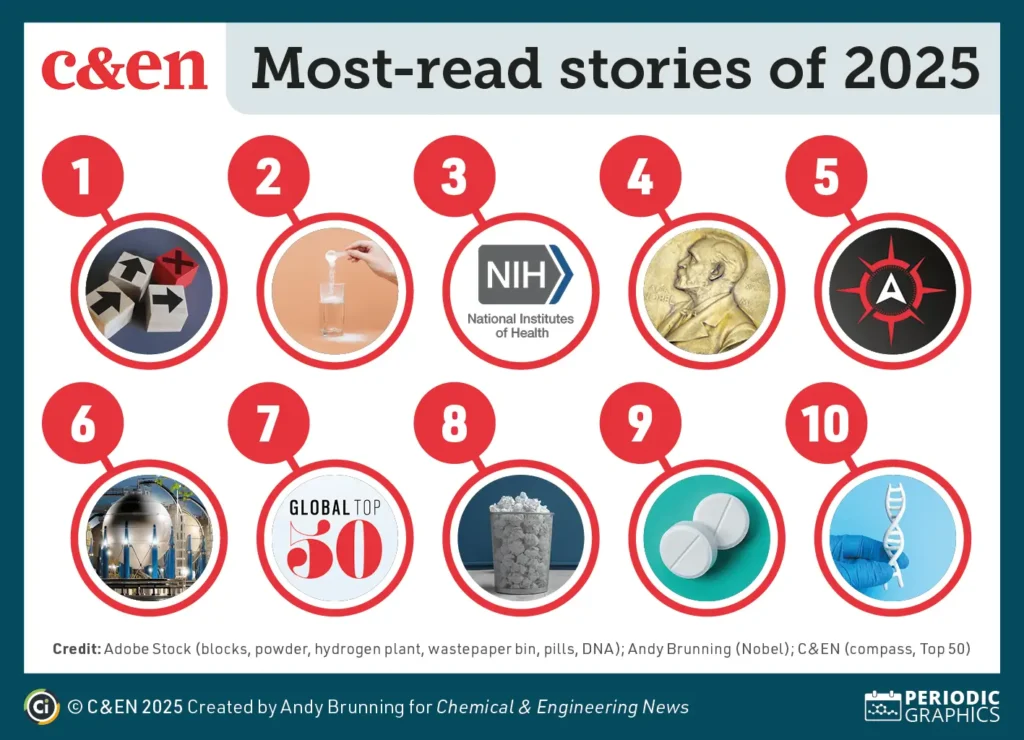
For marketers, these changes matter. If your audience includes scientists, staying informed about the issues shaping their work is essential for building trust and relevance. That’s why we’ve rounded up the five most-read C&EN articles of 2025. Read on to get more insights into what these stories reveal about your audience and to get ideas for your own content marketing.
1. The ethics of peer review under scrutiny
“1 in 5 chemists have deliberately added errors into their papers during peer review, study finds” was the most-read C&EN article of 2025. In October, C&EN reported that more than 20% of chemistry researchers say they’ve added incorrect information into their research papers during the peer review process. The reason? It’s not that they’re initially adding incorrect information. Instead, during peer review, 22% of surveyed chemists said they felt “forced” to add what they believed to be incorrect text to get the paper published.
Peer-reviewed research is the most valuable, rigorous, and important source of scientific information. It’s the place scientists go to solve problems in their work. The C&EN article, however, shows just how tenuous this content can be.
What this means for science marketers:
The scientific community pays close attention to the state of peer-reviewed research and cares deeply about ethical publishing practices. If you’re a marketer whose product deals with data management and integrity, consider how your organization can help scientists share and document accurate data. Another option is to show how your product helps researchers effectively navigate the peer review process.
2. We keep finding heavy metals in consumer products

In 2024, news that scientists had detected lead and other heavy metals in tampons went viral. This year, a similar story caught the C&EN audience’s attention: “Why scientists found lead in protein powders.” The article reports on findings from Consumer Reports, which tested 23 different protein powders and shakes. Over two-thirds contained what Consumer Reports researchers consider to be concerning levels of lead (based on limits set by the California Office of Environmental Health Hazard Assessment). The article then goes on to give context for the finding and explain how lead ends up in protein powders and other consumer products.
For the science marketer, there are a few takeaways here.
Chemical contaminants and quality are a huge concern for scientists and non-scientists alike. If you have a technology that helps scientists catch contaminants and other quality issues, show your audience that you understand why those contaminants are an issue and what the consequences for their customers are. There’s a clear interest in the broader impacts of quality control and ensuring the integrity of chemical products.
Another takeaway? Find ways to connect your products to discourses in popular culture. Your target audience—scientists—have interests outside the lab. They drink protein shakes!
3. A “banned words list” stokes frustration, confusion

Of all the news emerging from the federal government’s changes to scientific research and institutions this year, the one most read by C&EN’s audience touches on the current administration’s ending of diversity, equity, and inclusion (DEI) initiatives. In “NIH director Bhattacharya denies banned word list in meeting with staffers,” C&EN reported on allegations that NIH leadership were flagging certain words and phrases in grant applications and that grants containing those words were being denied.
Another C&EN article, “NSF terminates over 1,000 grants in 2 weeks,” was the magazine’s 14th most-read article of 2025.
These highlight two key priorities for the chemistry community:
- Research funding. In previous years, the US federal government is estimated to have funded approximately 50% of the scientific research. Abrupt changes to federal funding processes and sources have both an immediate impact on researchers and a downstream impact on their ability to carry out research or hold certain jobs. If your organization provides research or grant funding to scientists outside of your organization, make that known to the research community.
- Chemists are interested in DEI topics. In fact, in a recent survey, C&EN BrandLab found that “DEI in chemistry” was popular among C&EN and ACS audience members aged 18 to 34, as well as those in academia. If your target audience falls into these groups, don’t neglect sharing your brand’s advocacy efforts or personal stories.
4. Nobel Prize week is science’s Super Bowl
C&EN’s fourth most-read article for 2024 taps into the anticipation many chemists feel the first week of October: who will win this year’s Nobel Prize in Chemistry?
In “It’s Nobel time. Experts predict who will nab the 2025 chemistry prize,” C&EN reported on various polls and discussions predicting who would win this year’s prize. One of those included a webinar hosted by C&EN executive editor Laura Howes. An audience poll showed that most webinar attendees thought the researchers behind GLP-1 weight loss drugs would win in 2025. (The prize ended up going to Susumu Kitagawa, Richard Robson, and Omar M. Yaghi, who all played key roles in developing metal-organic frameworks).
The takeaway for science marketers?
Nobel Prizes continue to be a big deal for the chemistry community. Participate in the chatter leading up to the award. If the awarded technology is relevant to your own organization or product, say so. More broadly, keep track of the major science awards and the technologies they recognize. Though the Nobel Prizes typically recognize technologies that have already had a big impact, there are also cases where the prize recognizes a technology that still has outsized potential. Think CRISPR-Cas9 and AI-powered protein folding predictions. These are technologies your audience is paying attention to and perhaps learning how to incorporate into their own research.
5. Chemists with disabilities in the spotlight
Rounding out our list is one of my favorite issues from C&EN’s 2025 coverage: the magazine’s annual Trailblazers issue shared stories from chemists with disabilities. Profiles of 12 different researchers shared their personal experiences with disability and the important research questions they’re trying to answer.
If we design tools for only one way of sensing, we limit not only who can participate—but what science can become.”
– Mona Minkara in Trailblazers
This series matters because of lingering stereotypes of who can be a chemist and how chemistry is carried out. Mona Minkara, who edited the issue, writes, “When science began emphasizing what could be measured and observed, plots, spectra, and molecular models took over as chemistry’s visual language. For blind scientists, such tools remain difficult, if not impossible, to access…If we design tools for only one way of sensing, we limit not only who can participate—but what science can become.”
Takeaway for marketers:
For marketers, this series emphasizes a point made earlier: that the C&EN and ACS audience cares about personal stories and DEI in chemistry. In 2026, consider auditing the accessibility of your marketing materials and product offerings and making changes to improve how audience members of all abilities can interact with that content. If you need help getting started, ACS has published an Accessibility section in our Inclusivity Style Guide with best practices and examples.
And don’t neglect the power of personal stories when it comes to your own brand marketing efforts.
Bring Trending Topics in Chemistry into Your Next Campaign
Want help incorporating trending topics into your next marketing campaign? Connect with the C&EN BrandLab team!
Download our custom content guide to learn more or request a consultation to ask how we can support your next campaign.