

It’s no secret that stock photo libraries are filled with outrageously bad science stock photos.
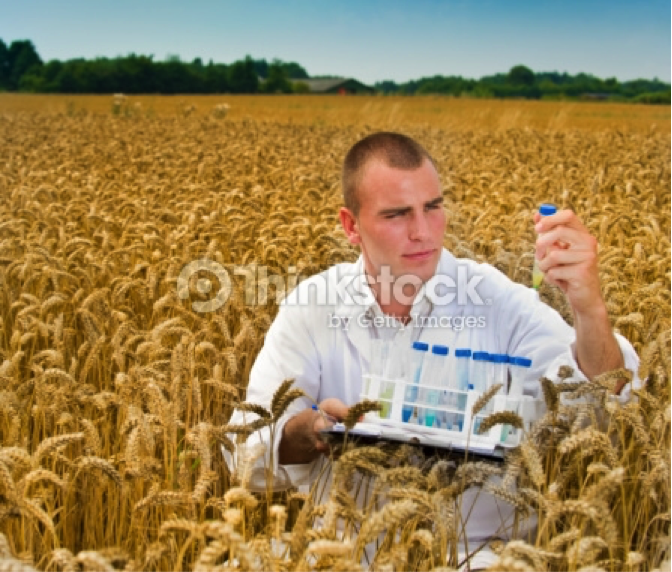
Like this one, with a “scientist” crouched in a wheat field for no reason:
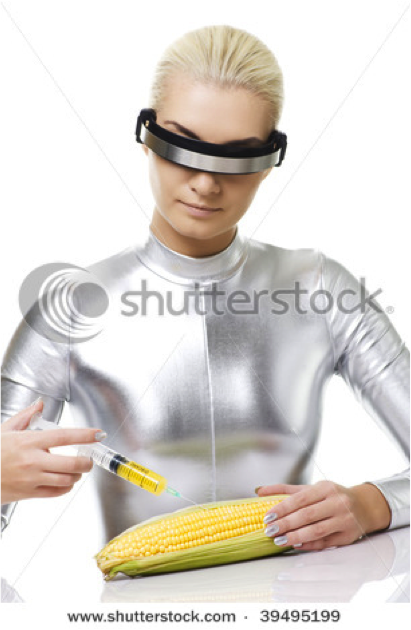
Or this one—that corn must be overdue for its flu shot:

Or this one, which was featured in a viral Twitter thread from 2022 documenting the worst science stock photos:
It’s easy to point out these bad photos, and they’re good for a laugh.
But, as funny as these images are, they point to a real challenge: science marketers rely on stock photos to represent complex work and concepts, but finding “good” science stock photography is exceptionally difficult.
For this article, I met with Matt Radcliff, executive producer for ACS Productions, and Jesse Harris, a fellow senior editor with BrandLab, about the challenge of sourcing science stock photos. We talked about what these photos tend to miss, how generative AI fits into the conversation, and the number one thing to prioritize when selecting science stock photography.
Authenticity, Above All
Sometimes you’re just looking for a stock photo that will set a tone for your content, break up text, or give a piece some color.
But, when you start to use stock photography to represent people at work performing tasks and interacting with their environment or real scientific entities, aesthetics aren’t good enough.
The biggest mistake you can make is that the photo doesn’t show something that feels like a real working environment. It looks like a made-up thing.”
– Matt Radcliff, Executive Producer for ACS Productions
Take this science stock photo as an example:

It’s an image of a person dressed in a lab coat staring intently at a glass test tube filled with a bright blue fluid. It conveys a tone of serious, scientific curiosity.
But if you’re trying to communicate with scientists, that’s not what they see.
Instead, they see:
- A piece of glassware that would never be handled in that way
- Personal protective equipment (PPE) missing
- Colorful liquids that are relatively rare in most research labs…
In short, the scientists in your audience may end up seeing this as an example of choosing to use a “nice” image instead of doing the work to understand what their work actually looks like.
Photography is a form of communication. When stock photos are used well, they can provide both an aesthetic role and communicate credibility. Misrepresenting science or scientists-at-work is a missed opportunity to connect with your audience.
What Makes a Science Stock Photo Feel Authentic?
In my role as an editor with BrandLab, I often track down stock photos to use in our white papers, e-books, and other sponsored content. Over the years, I’ve spent hours looking for good stock imagery options, trying countless iteration of search terms, going down rabbit trails of different photographer portfolios, and calling to mind the science labs I’ve worked in and have visited.
It’s hard to identify science stock photos that feel authentic if you don’t know what it looks and feels like to work as a scientist. But the physical experience of working in a lab is a core element of what it means to be a scientist, and scientists form community around these shared experiences.
Imagine you saw a picture of someone eating soup using a knife instead of a spoon. You would instantly notice that it looked off, and that would confuse and distract you. That’s how scientists feel when they see photos of people using pipettes or glassware incorrectly.
– Jesse Harris, Senior Editor at C&EN BrandLab
So, short of going back to school to get a chemistry or biology degree, how can marketers train their eyes for authentic representations of science?
Shadow a Scientist
Ask to spend a day shadowing one of your organization’s scientists in their lab or manufacturing center. Observe what’s happening. Write down what you hear, smell, see, and feel. Watch to see how their body moves, what PPE you put on, and when. Ask questions, lots of questions.
Get Feedback
Ask a scientist you work with or someone from your organization who trained as a scientist to critique stock photo options you are weighing. “Does this follow lab safety?” “Is the model using this equipment correctly?” If they do identify issues with the photo, ask how distracting they are.
Draft Guidelines for Your Organization’s Use of Stock Photos
A list of non-negotiables for your brand’s use of stock photos can make it easier to sift through the thousands of options. Rules like “If someone is shown in a lab, they need to be wearing a lab coat,” will mean you can ignore photos where lab coats are missing.
Can You Spy the Problem with these Science Stock Photos?
The photos below are not bad science stock photos. I’ve even used one in a white paper.
But there are subtle details in each that could be a problem, depending on the context. Can you find them?


This is a decent photo, but the model’s hair isn’t tied back. There might also be an issue with wearing gloves while using a tablet, but it does depend on the lab and the chemicals they use.

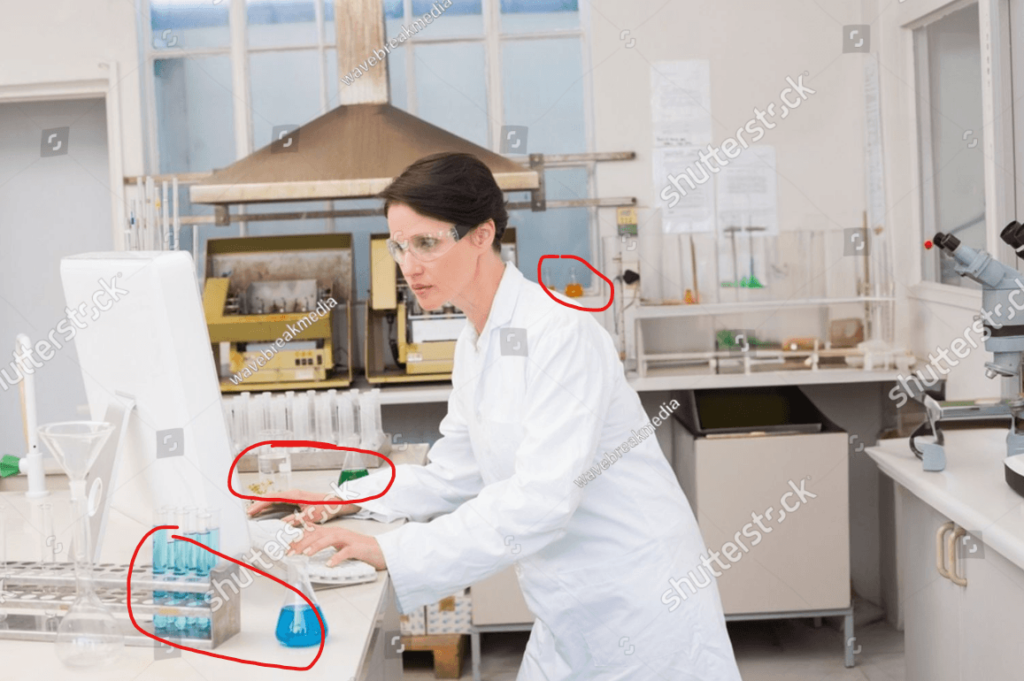
I like that the lab feels a bit older and worn in. That is fairly typical for academic labs and even some industry labs. And the model’s PPE seems appropriate. However, there’s a lot of glassware filled with bright blue, yellow, and green liquids, which is not common. More importantly, there’s a safety issue: those liquids are unsecured and staged in odd places, including next to a computer.


This is a good photo! The model is working in a biosafety cabinet with the glass partition down and nothing obstructing the front grill’s airflow, and they seem to be using a pipette correctly. The liquid in the tube with the orange cap is pale pink, a common color for cell culture media. The only potential issue is that the model isn’t wearing safety glasses; but, if there’s no risk of splashing or of getting harmful chemicals in their eyes, they might not need safety glasses. PPE is contextual.
What about Generative AI?
We can’t really talk about stock photos in 2026 without also discussing generative AI. Generative AI has expanded what marketers can create, but it’s also expanded how easily inaccuracies can slip through.
When it comes to using AI to generate imagery for your brand content, Matt recommends caution:
The phrase ‘a picture is worth 1000 words’ holds true in this case. It’s easier to review a written thing that was AI-generated and harder to review a picture that was generated because there’s so much more information packed into a picture.”
– Matt Radcliff, Executive Producer for ACS Productions
In addition to checking AI-generated images for errors, you should also consider why you’re using a photo in the first place. If you’re looking for something to communicate authenticity and connection, artificially generated images of scientists at work probably aren’t the right fit. Similarly, if your goal is to accurately convey the structure of a molecule, how confident are you in your ability to assess and correct the accuracy of an AI-generated image?
One role generative AI can have in using science stock photos is the way it can make photo editing easier and faster. For example, you find a stock image that is nearly perfect, but the model isn’t wearing goggles or gloves. You don’t want to use an image that shows improper PPE. In a case like this, it’s reasonable to use AI-based tools to quickly add gloves and goggles to the person.
These are the sort of edits that someone who is trained in photo editing software can make relatively easily on their own. In this case, AI makes that process easier for marketers who do not have that expertise.
One more note: using generative AI may also introduce risks involving image licensing and copyright concerns. In addition to whatever brand standards your organization has set, weigh the ethics of your use of generative AI.
What Else Should You Look Out for in Science Stock Photos?
Keep an Eye Out for Representation
For a long time, science stock imagery reflected stereotypes of who can be a scientist. That limitation is improving, says Matt, but it’s an issue to be aware of when selecting photos.
Stock photography can provide representation in a stand-alone piece of content. It cannot, and should not, represent the extent of your organization’s commitments to support and foster an inclusive workforce. There is a fine line between choosing stock photography that represents the diversity of science and using stock photography to tokenize groups.
Safety is in the Details
Safety is a non-negotiable in the lab. The challenge for marketers is knowing what behaviors and equipment are considered “safe”. And it’s complicated by the fact that safety is contextual and depends on the lab, the substances being used, and the tasks being carried out.
Eating in the lab? That’s a hard no. Wearing gloves? It depends.
Here are a few safety elements to keep an eye on when selecting stock photos:
- Knee-length, buttoned-up lab coats are usually standard for biology and chemistry labs, as are full-length pants or skirts and closed-toe shoes.
- Gloves typically shouldn’t be used when working on computers or tablets in a lab.
- If your organization has its own labs, there are likely standard rules for PPE. Try to learn what those are and look for stock photography that follows those guidelines.
Are Graphics Accurate?
Every time I see a helical structure of DNA in a stock image, I check to see if it’s right-handed. Similarly, when I see a chemical structure, I’m looking at bond geometries and connections. If a graphic of a real chemical or biological entity is shown in the stock photo, I consider whether it makes sense to show that specific structure in context.
Is it Time for a Photoshoot?
With all the issues surrounding stock photo usage, I’d advise organizations who have labs to consider building their own collection of stock photos, taken with their employees in their lab spaces with their equipment.
This is no small investment. In addition to the employees’ and photographers’ time on the day of the photoshoot, there’s also planning and prep time, and the photographer will need to edit the photos. You’ll also need a system in place to store the images, tag them with the proper metadata, and make them available to others in the organization. You’ll also want to take new photos every few years so that your images don’t feel too dated.
Hosting a photoshoot and setting up a photo library may not be feasible, especially if your organization does not have lab spaces or scientists to photograph. If you can’t build and host your own library of photos, invest that time in honing your instinct for authentic science stock photos through audience research, shadowing scientists, and asking lots of questions.
Create Impactful Content That Connects with Scientists

If you’re looking to go deeper into how to create science content that resonates with real scientists (beyond just choosing a good stock photo) the BrandLab team has an on‑demand webinar you might find helpful.
In Creating Content that Scientists Can Resist, two of our scientists turned content marketers unpack what makes technical storytelling credible, compelling, and trustworthy. You’ll learn how to translate complex research, elevate SME insights, and develop content that connects with your scientific audience.