

April is Earth Month, which means sustainability messaging is everywhere. Brace yourself for leaf icons and sustainability promises all over social media! For many marketers, this raises an uncomfortable question: how do you talk about environmental impact while staying honest?

That challenge becomes even sharper when your audience is chemists, engineers, and other scientists. These are people trained to spot weak evidence, sloppy comparisons, and misleading shortcuts. Not only that, but scientists really care about sustainability. Almost 50% of chemists said they were “interested” or “very interested” in this topic in a recent survey. If your sustainability story doesn’t hold up to scrutiny, you won’t just fail to persuade — you’ll lose credibility.
With the stakes this high, it’s essential to be purposeful and clear about your approach. Let’s explore where greenwashing risks arise and how to market responsibly.
Greenwashing — What it is, and How to Avoid it
First, it’s critical to avoid greenwashing. This is the practice of making products or services seem more environmentally friendly than they really are. This obviously includes lying, but it also covers many other forms of misrepresentation. Not only is the practice dishonest, but getting caught using greenwashing tactics could harm your brand’s reputation — and it could face legal action. Many scientists — especially chemists — are quite sensitive to greenwashing, so you should avoid the practice.
But what exactly counts as greenwashing? One useful framework is the “7 sins of greenwashing.” Remembering these “sins” helps us market responsibly and to avoid being duped by shady marketing practices ourselves.
The Sin of the Hidden Trade-Off
Imagine I invented a plastic that used 10% less oil to produce. Sounds good, right? But what if I did not mention that it also takes 100x more energy to manufacture? Not so good anymore…
This is an example of a hidden trade-off; there is an environmental benefit, but also a cost. While trade-offs are often necessary, it’s important to be honest about them. Don’t position your trade-off as a sustainability win when the broader picture is more complex.
The Sin of No Proof
You claim your product has less environmental impact than competitors’, but does it really? It’s not enough to believe you’re saving carbon emissions or protecting endangered ecosystems — you need real evidence.
This is especially important when marketing to scientists. They want experiments, peer-reviewed research, and high-quality data.
The Sin of Vagueness
Have you ever seen a product that claims to be “green,” “eco-friendly,” or “sustainable,” but you are unsure what makes it special? Was it made using solar energy? Does it use sustainably sourced ingredients? Is it handmade by GMO-free penguins in Antarctica?
While the product may be environmentally friendly, the buyer should understand the real benefit.
The Sin of Worshipping False Labels
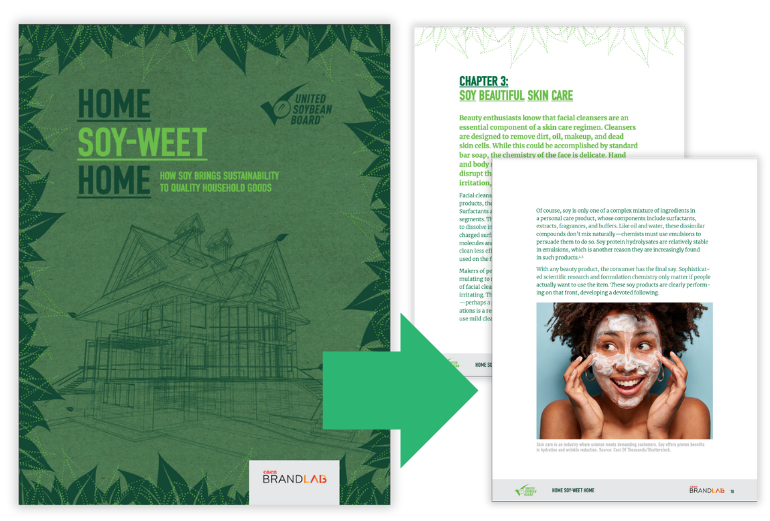
Buyers (both B2C and B2B) rely on packaging and label information to make purchasing decisions. Adding green colors, “seals of approval,” or nature-themed iconography suggests that the product is sustainable. Using these signifiers to make something “look” more environmentally friendly than it really is would be deceptive.
The Sin of Irrelevance
Imagine I told you I had invented a new type of plastic that required 10% fewer rare earth metals to manufacture. That sounds nice, but should you care? Does plastic production even require rare earth metals (they don’t)? This is an example of greenwashing because you are implying the environmental benefit is more substantial than it is.
The Sin of the Lesser of Two Evils
Imagine I told you that a 2026 version of a gas-powered heavy-duty SUV had 10% less CO2 emissions than the 2025 edition. That’s nice, but the comparison is dishonest. All gas-powered heavy-duty SUVs are terrible for emissions, so you should pick a totally different type of vehicle if you care about carbon.
Don’t select your comparison only because it makes you look better. Measure yourself against a realistic alternative.
The Sin of Fibbing
This includes lying, exaggerating, misrepresenting, or otherwise obfuscating environmental impact. Yes, this does happen. Just ask VW.
These greenwashing practices are still used by many marketing professionals. Recognize them, avoid them yourself, and call them out if you see others in your organization using them!
Supporting Claims with Quality Evidence
Scientists are an analytical bunch. This is well-known, but many people misunderstand how scientists interact with facts and data. It isn’t enough to throw any random numbers in their direction. Rather, you should think of scientists as data enthusiasts or connoisseurs — they want facts that are high quality, fresh, and precise.
This is especially important in the field of sustainability, where there is a lot of information online, but the quality is inconsistent. Watch out for “zombie facts” and “zombie stats,” which are claims that are repeated online but are wrong or unverified. Here are a few samples you might have come across:
Examples of Zombie Facts and Stats
- Paper is better than plastic → this depends on the application and how you measure. Plastic is better than paper in many respects and use cases.
- AI uses a bottle of water for every prompt → this claim is based on older technology. Water usage varies dramatically for different types of prompts.
- Electric vehicles are worse for the environment than gas cars → that is only considering manufacturing emissions. Even on coal‑heavy grids, electric vehicles usually outperform gas-powered vehicles over their lifespan.
Versions of “facts” like this show up on the internet all the time. Do not trust them without verification! While the people sharing these points are often well-intentioned, they are repeating facts that fit with their existing beliefs. You need to rise above this standard when communicating with a scientific audience.
You should also verify that your data is up to date. Sustainable technology and regulation are changing rapidly. Consider solar panels — their costs have dropped over the last 20 years, leading to a surge in demand. Global use doubled from 2021 to 2024… just three years!
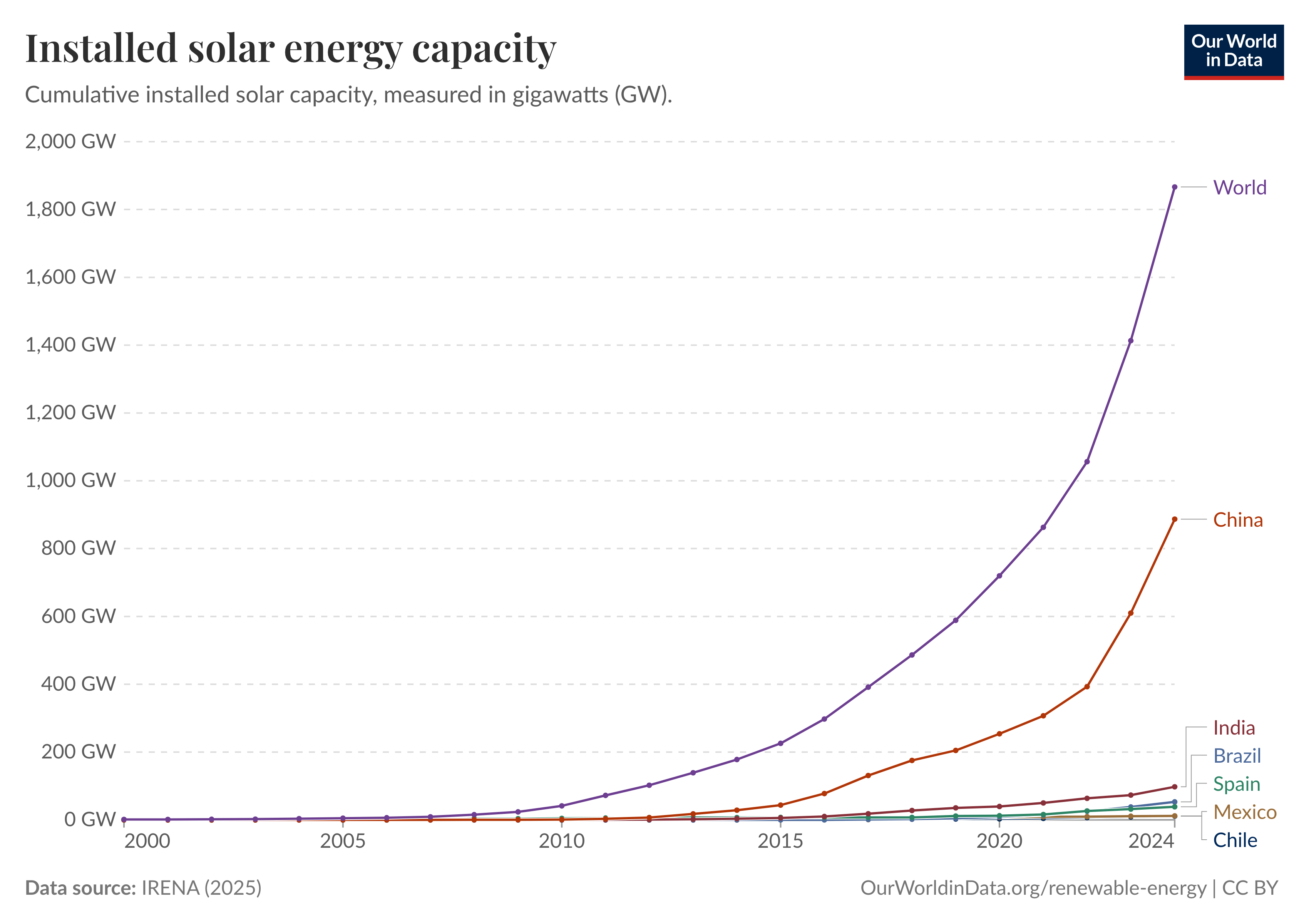
This means that any statistic on solar technology more than three years old should be viewed with suspicion. Scientists working in this field will know that your fun facts from 2015 are wildly out of date.
It is also worth remembering that the details matter when sharing sustainability-related statistics. Let’s say that you come across the claim that ACME Inc. emitted 1 million tonnes of CO2 from 2011 to 2020. Seems clear enough, right?
- Was that 1 million tonnes per year or 1 million tonnes total?
- Was that CO2 emissions only, or was this “CO2e”, which includes greenhouse gases beyond CO2?
- Does this include only direct emissions (scope 1), or does it cover indirect emissions (scope 2 and 3)?
The answers to each of these questions could give you a very different picture of ACME Inc.’s environmental impact. You need to be clear on what the original source claims and ensure that you get the details right when you reshare it.
“But wait a minute,” I hear you say. “Fact checking, assessing recency, confirming details; isn’t that a lot of work?” Yes, it is. You need to use critical thinking and research skills here. It’s not enough to search the internet for a fact you like to drop into your white paper or blog post. Getting this wrong erodes trust.
Tell a Sustainability Story

While data is essential, it’s not enough to deliver a compelling, memorable message. It is best to weave it into a story.
- Where exactly is the environmental benefit coming from?
- How big is the impact in practice? Can you give a comparison?
- How did your team discover or develop this environmental benefit/feature?
Take this sample:
“Nano-Plex coatings emits 20% less CO2 than traditional polyurethane coatings.”
Meh. It is an interesting fact, but it lacks the context and drama to stick. It’s better than nothing, but not by much.
“Our team developed the new Nano-Plex coating to meet the needs of homeowners who wanted a protective stain for decks and fences that was environmentally friendly. Polyurethane coatings offer effective water protection, but did you know that each gram produces 5 grams of CO2? Nano-Plex has 20% less greenhouse impact, thanks to our proprietary nano-solvent technology, which captures CO2 rather than releasing it.”
While this is longer and may not be appropriate for all applications, it is much more memorable. We set up the tension (the need for a coating that was environmentally friendly), which is then resolved. We have also linked the benefits of environmental sustainability to the product’s features.
This is a relatively simple example. It would be better to introduce characters, setting, and more plot, but this is a start. Once you find these compelling stories, you can retell them through different formats and channels.
Don’t Force It
But what if your brand doesn’t have a sustainability story to tell? How do you engage in the conversation? Should you sit out the whole month of April?
Here are a few ideas on what you could do:
- Are there any environment-related companies or organizations using your product/service?
- Are there any interesting sustainability-related facts that you can share, even if they are not unique to your product?
- Does your company engage in any environment-related philanthropy or community service?
But honestly, if you don’t have a clear sustainability story to share, consider spending your time and energy as a marketer elsewhere. Don’t fake it. Your product/service/company doesn’t need to do everything. People can smell when you are being inauthentic.
Take this extreme example:

While you probably won’t get dunked on like BP, forcing your brand into the wrong conversations is how you get greenwashing. No one expects your company to participate in every themed celebration throughout the year. Pick where you can have the most relevance and then show up in a way that breaks through the noise.
Craft Sustainability Marketing Scientists Trust
If you’re navigating sustainability marketing for scientific audiences, BrandLab can help. Our work is led by Ph.D. scientists turned marketers who know how to turn complex data into trustworthy, resonance-driven content, without overstating claims or risking greenwashing.
Start with our custom content guide, or schedule a consultation to learn how we work.