

We all try to win arguments with facts. At work, at home, on the internet. If you’ve ever pulled up a chart, statistic, or peer-reviewed paper to prove a point—or watched someone else do it—you know the instinct. It’s logical. It’s persuasive. It’s…scientific.
But here’s the problem: facts, data, and metrics alone rarely change minds. And if you’re marketing for a science organization, that matters.
Facts and the truths they represent are essential to effective, ethical communication. But decades of research show that even when facts are available and accessible, they are not necessarily effective at changing behaviors or sentiments.
Science communicators—people who help bridge the gap between technical scientific discoveries and broader understanding of science—navigate this tension every day: how do you present a message about science to people in a way that holds their attention, stays in their memory, and, ultimately, causes a change in their behavior or attitudes.
These goals are not so different from those of a science marketer.
Shane M. Hanlon, BrandLab’s executive editor, and I explored this idea in a webinar. As two former researchers who have been involved in science communication (scicomm) efforts and are now working in science content marketing, we’ve seen how research-backed “scicomm” best practices can align with marketing efforts.
In many ways, science communication is the marketing of science.”
– Shane M. Hanlon, Executive Editor, C&EN BrandLab
Where Facts Fall Short
Early efforts in science communication operated on the premise that people’s negative attitudes toward science are the result of a lack of scientific knowledge.
In a 1983 review on the concept of science literacy, Jon D. Miller writes:
“Scientists and engineers are…showing a new level of willingness to explain their problems and aspirations to interested lay audiences. But…there must be an audience capable of understanding both the substance of the arguments and the basic processes of science. We can accomplish this by addressing, without delay, the educational needs of the attentive public for science policy.”
In other words, once people understand science, they’ll understand scientists’ communications; attitudes toward science would improve, and science-backed policies and funding for scientific activities would surely follow.
The goal of science communication, therefore, had long been to correct audiences’ “deficit” of knowledge. This so-called deficit model, however, has been shown time and time again to fail in those goals. Its central failure is that it neglects the attitudes, worldviews, and receptivity of audiences.
An example from the scicomm literature that illustrates this point nicely comes from Caitlin Drummond and Baruch Fischoff. In a 2017 study, they examined how people’s science literacy, science education, and general education correlated with their beliefs toward a range of potentially controversial scientific issues, including genetically modified foods and climate change.

If the deficit model held, we’d expect that as science knowledge and literacy increased, the range of opinions about scientific topics would be narrower: people would have similar attitudes. For those with less knowledge of science, there’d be greater polarization and range in beliefs.
The study found the opposite.
On certain topics, peoples’ attitudes became more polarized as their science knowledge increased. Instead of scientific knowledge, people’s attitudes correlated more strongly with their religious and political attitudes.
Despite evidence like this, many scientists and science-trained communicators default to the deficit model when communicating with the public. Part of this is likely because of how scientists are trained, which rarely includes formal communication training beyond preparing manuscripts, grants and research presentations.
For the scientist-turned-marketer, it’s important to acknowledge that you might have an instinct to promote the facts about your product: If my target audience only knew about this product and what its capable of, they wouldn’t be able to resist.
But asking people to change behaviors or beliefs is not so simple. Your audience is not an “empty vessel” waiting to hear about your product. They are complex individuals with distinct worldviews, experiences, and priorities.
Yes, audiences absolutely need facts to make informed decisions. But if we rely solely on facts and think we’ll change minds by filling a deficit of knowledge, we sell ourselves and our products short.
The Case for Story
As awareness of the deficit model’s failings have grown, one strategy science communicators have turned to is storytelling. Storytelling as a communication strategy is something most marketers will be familiar with and will have almost certainly seen is championed as an essential pillar of modern brands.
First off, what is storytelling?
Jerome Bruner, a founder of cognitive psychology who helped develop our understanding of how storytelling shapes beliefs and reality, provides a definition in Actual Minds, Possible Worlds:
[Narrative] deals in human or human-like intention and action and the vicissitudes and consequences that mark their course. It strives to put its timeless miracles into the particulars of experience and to locate the experience in time and place.”
– Jerome Bruner, Actual Minds, Possible Worlds
In short, storytelling as a method of communication involves characters, a setting, and cause and effect.
Why has storytelling captured so much attention as a communication strategy? Many research studies point to storytelling and narratives’ unique ability to get a message to “stick” within the minds of an audience.
A 1980 study looked at how well college students retained information from a narrative rather than exposition. The researchers found that students better retained the information from the narratives, even when they were already previously familiar with the information.
In addition to improving an audience’s ability to recall information, researchers have also found that stories make people less resistant to new ideas.
In a 2000 study, researchers found that when information was presented in narratives that included elements that “transported” readers into the narrative, readers’ beliefs were momentarily shifted and had less resistance to ideas they otherwise disagreed with.
What makes a story stick?

Not every story is equally effective. Even a well-constructed scientific research talk will embody elements of storytelling and narrative, but that doesn’t mean its message will necessarily land or stick.
So, what makes for a good story?
According to a cohort of storytelling scholars, the most effective, memorable, and affecting stories incorporate the following elements:
- They include people
- They help the audience visualize a setting
- They’re framed in a way that accounts for the audience’s worldviews
- They leave some ideas unsaid, giving the audience room to make connections
For content about science and scientific topics, the scale of the storytelling and the ways you incorporate these elements is vast. On one end of the spectrum, you can have a long-form content series with video and written stories that are driven entirely by personal stories, incorporate rich details, and a strong but subtle thesis.
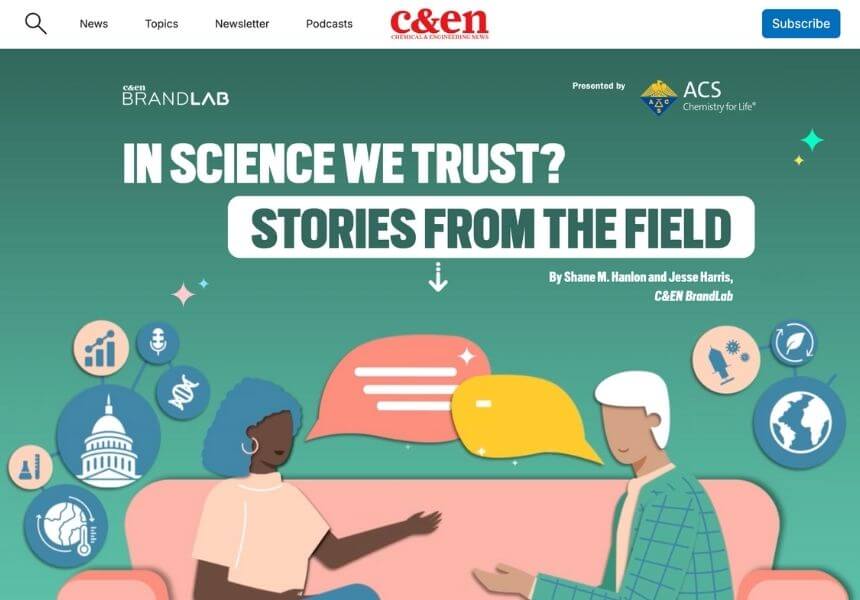
For example, check out this multimedia article for an example of using personal stories to communicate. C&EN BrandLab produced an audio series for ACS that explored real-world examples of how trust in science can be (re)built.
In addition to incorporating personal stories, the BrandLab team included edited audio recordings of the interviews to reinforce a central theme: the importance of listening and engaging in a true dialogue when communicating as a scientist and as a person.
At the other end of the spectrum, you can weave smaller scale stories into your content, even content that includes highly technical information.
In an e-book C&EN BrandLab produced for the US Soybean Board, we incorporated a researcher’s personal experience to show (and not tell) that soy-based inks are safe:
“‘A company said they wanted to do baby foot printing with soy ink,’ Sevim Erhan says. ‘At first, I thought they were making fun of me because everyone knew I was pregnant! I quickly developed the ink, and my daughter turned out to be the first baby in the US to be footprinted with soy ink.’”
Read more C&EN BrandLab examples of how to incorporate personal stories into your marketing.