
For years, marketers have debated whether email is losing relevance. But despite the claims, email remains one of the most powerful channels for science marketers. It’s a direct line of communication to your audience, arguably the best place to build a genuine relationship.
But the rules are changing fast.
Today’s younger and digitally native audiences have new expectations for who can show up in crowded inboxes and earn their attention. At the same time, fatigue from too many messages has made traditional email strategies less effective than they once were.
Science marketers need to rethink their approach, from subject lines and timing to the value each email actually delivers. It’s all about evolution, and those who adapt will see benefits. Here’s how to upgrade your 2026 email marketing strategy.
Audience Expectations Have Changed
“Email is such an integral part of all of our lives,” said Shane Hanlon, Executive Editor at C&EN BrandLab. People still check their inboxes regularly; it’s often the first thing they do in the morning and the last thing they do at night.
What’s changed is what audiences expect to see once they open their inbox: high-value messages that help solve a problem, answer a question, or serve a specific need. Emails should have clear utility and be easy to consume.
“Emails that are just large blocks of text with heavy language don’t get as much engagement,” explained Bek Ergashev, Assistant Director of Marketing Operations and Analytics at ACS, noting a shift he’s seen with younger, more tech-savvy audiences more quickly dismissing low-value emails. “AI slop is real,” so be cautious when relying on automation to develop the content.
Instead, conversational tone and thoughtful design are increasingly important.

There’s something that feels special about a human curating something for your attention.”
– Shane Hanlon, Executive Editor at C&EN BrandLab
For science marketers specifically, one of the biggest misconceptions is that scientists are more tolerant of dense or lengthy content. Hanlon strongly disagrees.
“Attention still needs to be grabbed,” he explained, regardless of the audience type. Scientists may be willing to go deeper, but only after the initial hook, which means packaging is just as important as the writing.
“Headers and taglines make a world of difference,” Hanlon emphasized, noting that marketers often invest heavily in content creation but overlook the gateway to engagement.
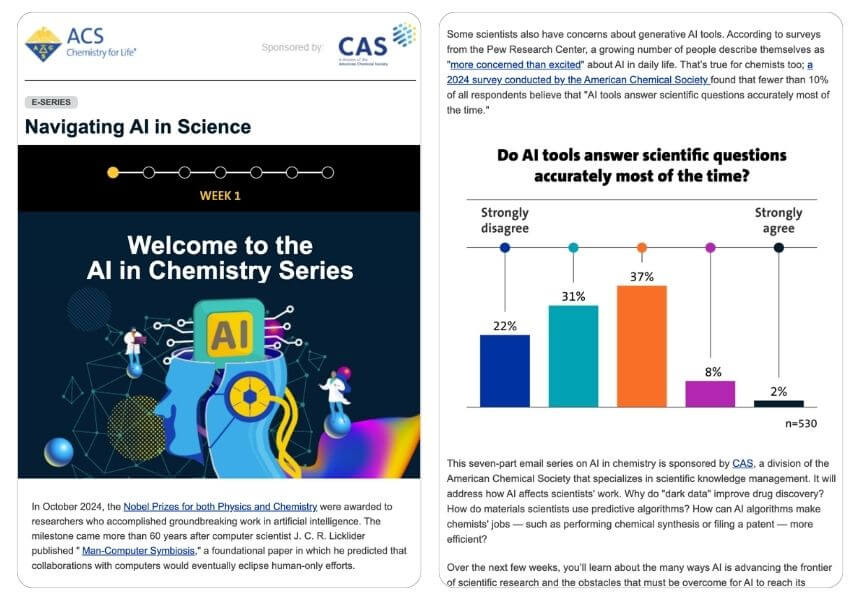
He also pointed to the power of curated newsletters. When content feels intentionally selected rather than mass distributed, audiences respond differently.
“There’s something that feels special about a human curating something for your attention,” Hanlon said.
This is also where giving audiences more control over what they receive becomes increasingly important. Rather than relying on one-size-fits-all campaigns, make it easy for your audience to self-identify their interests. Curated e-newsletter subscriptions, focused on a specific scientific discipline or career stage, for example, allow audiences to opt into content that feels directly relevant to them.
Email series can also play a role here. Think: educational series around emerging research areas or topic-based nurture tracks that allow audiences to sign up for content they’re most interested in.
Takeaways for Marketers
- Lead with a strong hook to capture attention, even for technical audiences.
- Prioritize editorial framing versus announcements, and avoid long, dense paragraphs.
- Write subject lines that communicate the value of the email from the audience’s perspective.
- Make it easy for audiences to self-select their interests through topic-based newsletters and email series.
Email Fatigue Is a Hidden Threat
While engagement tactics are evolving, many organizations still face a more fundamental challenge: sending too many emails.
Ergashev said large organizations, in which multiple business units independently email the same audience, are particular offenders.
“People don’t see disparate units; they only see one entity,” he explained. “If they get six emails a day from the same organization, they see them as over-emailing, even if those emails were from different business units.”
Over-communication creates fatigue and ultimately damages long-term engagement. Email service providers watch audience signals to determine senders with low engagement, and many deprioritize them in their audiences’ inboxes.
To monitor and address email fatigue at ACS, Ergashev’s team analyzes audience saturation using AI tools, identifying when contacts are “oversaturated” and automatically filtering them out or recommending pauses to rebuild interest.
“Give them time to miss us,” he said.
Takeaways for Marketers
- Audit the total email volume across your organization and identify audiences that receive multiple emails each week.
- If you don’t have AI tools to identify fatigued audiences, define what a “fatigued” contact looks like to you. Ex: someone who receives more than 5 emails per week.
- Test reducing frequency for high-volume segments and build suppression lists for fatigued audiences.
Email Metrics That Matter
To truly understand engagement, it’s critical to look beyond vanity metrics.
“Open rates, unfortunately, are just vanity,” Ergashev explained, noting that automated email opens from platforms like Apple Mail distort performance data.
At the same time, inbox algorithms are getting smarter. In addition to prioritizing senders, AI now sorts messages based on relevance, meaning engagement signals matter more than ever.

AI is sorting emails before people even see them, so delivery no longer guarantees visibility. AI might put your email in a folder your audience doesn’t even know exists.”
– Bek Ergashev, Assistant Director of Marketing Operations and Analytics at ACS
“We say emails were delivered 98% of the time, but we don’t actually know what ‘delivered’ means anymore,” Ergashev said. “AI is sorting emails before people even see them, so delivery no longer guarantees visibility. AI might put your email in a folder your audience doesn’t even know exists.”
Rather than rely on open rates, Ergashev and his team look at a broader set of indicators to understand the overall health of an email program, including:
- Deliverability
- Inbox placement
- Sender reputation
- Unsubscribe trends
- Non-vanity engagement metrics, like Click-to-Open Rate (CTOR) and forwarding activity
Email forwards, in particular, represent high-value engagement, since someone is essentially recommending your email to another person. “If somebody forwards your email, that’s a massive engagement,” Ergashev said.
Takeaways for Marketers
- Monitor deliverability and inbox placement. There are tools like Everest that can help.
- Track click-through and conversion rates versus open rates, which are often inaccurate.
- Monitor forward and share behavior to understand the relevance and utility of your message.
- Evaluate unsubscribe trends closely.
The Future of Email Engagement in Science Marketing
Ultimately, the new rules for your 2026 email marketing strategy aren’t about abandoning the channel, but about evolving with audience behavior and tracking best practices over time.
“What’s important is asking your audience what they want and using your data to see what they engage with,” Ergashev said. “It’s an iterative process. We test content, learn what works, and keep refining.”
Moving forward, the most successful science marketers will:
- Treat email as a long-term relationship channel.
- Prioritize audience value over brand announcements, and consistently deliver that value over time.
- Invest in packaging and storytelling to deliver content worth engaging with.
- Monitor holistic engagement metrics that demonstrate the email program’s actual impact.
- Invest in tools and technology to gain insights into email engagement.
In a fatigued inbox, the brands that win will be the most relevant, not the loudest.
And as Hanlon’s advice suggests, the path forward is surprisingly simple: “Make better emails.”