
Marketing to scientists is hard. Scientists are skeptical, technically demanding, and quick to disengage if something feels off. At BrandLab, a custom content studio with ACS Media Group, we specialize in creating content and leading content-driven campaigns for this exact audience.
Jesse Harris and I both started working at BrandLab in 2024 as senior editors. We’ve spent the last two years developing custom science content marketing campaigns for companies across the chemistry and life sciences industries, from CDMOs to instrumentation manufacturers. We sat down recently to reflect on what those two years have taught us — the lessons we expected, the ones that surprised us, and a few things we’re still figuring out.
Below is an edited version of our conversation.
Join Jordan and Jesse for a Live Webinar on June 30: Thought Leadership is Made for Scientists: How Marketers Can Help Scientists Shine
How to Deal with Skeptical Science Audiences

Jordan: Scientists are famously skeptical folks, right? They question, they inquire, they go, “Really? Are you sure about that?” And so I’m curious, when you think about what makes good content for this specific audience, what comes to mind?
One thing I think a lot about is flipping that idea of skepticism on its head. I really like the perspective that Hamid Ghanadan talks about in some of his writings, where skepticism is also an element of curiosity. The idea is to lead your content with “how do we engage curiosity” as a way to think about content for scientists. How about you?
Jesse: It’s something that is hard for me to put together in one pithy take. The one thing I would say is that getting your facts right is really important. That’s something that I’ve noticed working with partners during the writing process. You have to get the right nuance and explain things accurately and clearly.
At the same time, It’s easy to over-index on thinking about scientists as Spock-like rational actors who are just craving data. I think the way scientists are taught to communicate and the way scientific communication functions does us a huge disservice. We’re so focused on data and facts and results and experiments that we lose sight of narrative and context and problems.
It’s easy to over-index on thinking about scientists as Spock-like rational actors who are just craving data … we’re so focused on data and facts and results and experiments that we lose sight of narrative and context and problems.”
– Jesse Harris, Senior Editor at ACS BrandLab
One of the things that I know we have run into so many times is the importance of a title, the importance of email subject lines. If you get those wrong, if they’re not clear, if they are using too much jargon, they won’t resonate. And that sort of flies in the face of the Spock-like-scientist stereotype. Having a good title makes a difference, no matter how technically proficient your audience is.
Jordan: This goes beyond marketing, beyond science. It’s how to be a good communicator, right? The original question of “how do you engage with skeptical scientists?” becomes “how do you engage with an audience? What do you know should be true about your audience? How do you pull them in and keep their trust?”

Jesse: You have to have an almost sixth sense for finding what’s interesting for them and to be able to pull on that. Sometimes there is this idea that B2B content is boring. I really reject that because I think that technical audiences want technical content.
An outsider looking in could find it dry if they don’t fully understand the relevance, the context, or the players in the story.
But questions like, “how does this data system function within the drug development environment?” or “what are the advantages and disadvantages of different classes of biopharmaceuticals?” That’s genuinely fascinating to a relevant audience if you can have a clear, compelling take.
Key Takeaways:
- Don’t over-index on thinking about scientists as overly rational people who only want data.
- Narrative, content, problems, and emotion have a place in science content marketing
- Technical content isn’t inherently boring — but you need to find the right context and narrative
Misconceptions (and Instincts) in Science Content Marketing
Jordan: My next question has to do with the misconceptions or challenges marketers have with reaching a scientific audience. One that I think of, which is related to your point about boring content, is the assumptions we make about what content is interesting.
I will think something is interesting and do as much work as I can to stay attuned to what the audience is telling me, and follow popular articles on science news sites and journal articles that are trending. But it takes effort to step into that role, right? And to imagine yourself as the audience.
Do you have more to say about potential misconceptions or the difficulty in setting yourself within your audience’s experiences?
Jesse: One challenge is that you can’t rely on data to tell you what is or is not interesting to the audience. There are no tools you can use to get that information. It’s not like LinkedIn will tell me what the average scientist knows or about a given topic, or differences between what the average pharmaceutical chemist knows about different biological modalities.
You have to use your instincts a surprising amount. This is something I have been feeling recently: I develop and lean more on my instincts the more that I do this job.
Jordan: It is so encouraging to hear you say that because I have felt the same thing. Within our role, we often get asked by people, “How do you think this will resonate with your audience?” Well, I have survey data and recent trending topics that I dig into, but it’s also….Vibes. Instincts. We’ll call it instincts.
There is a whole discourse there about how much you absorb over your years, embodying a certain role and thinking about certain subjects, and how that gives you those instincts that you need to be successful. I think that’s true. Before I was an editor, I was a science writer who interviewed scientists. And before that, I got my PhD in chemistry, applied for grants, networked with other scientists, and followed science news and blogs. I have strong instincts for what the ACS audience is interested in because of that immersion. Still, it can be intimidating and scary sometimes, to say, “I’m making this decision and this is the decision that everything is telling me is the right one to make.”
Jesse: And that’s something that, as scientists, both of us are a little allergic to. It’s this sense of: I know what a good campaign looks like most of the time, and maybe I can’t call this 100%, but I have a pretty good sense as to whether this will work. And you have to trust that there’s a combination of seeing the right things and pulling it together in a way that makes sense, and that you can trust that.
I still do whatever I can to watch and read about what’s happening in the environment, so I can try to calibrate my instincts, too. I don’t trust them fully. So, it’s a weird relationship that I have with these instincts.
Key Takeaways:
- Sometimes, you’ll rely on instincts to tell you if a topic will interest your audience
- Calibrate those instincts by researching and paying attention to your audience
Last Thoughts for Science Content Marketing
Jordan: Is there one thing you want science content marketers to reckon with, and what would that be? Is there something our field needs to think about more carefully?
Jesse: It’s actually about staying on top of the fundamentals of marketing. Many science marketers come from a scientific background, and that means that they can get fixated on the science itself. They might talk about features and the nitty-gritty points, losing sight of the big picture. But focusing on things like positioning, strategy, and marketing effectiveness is truly important in doing good work. Good strategic thinking is so helpful for many aspects of work.
Jordan: You’ve written extensively about that, like on the Marketing Elements blog, and there is a need for that within our industry. I will “yes, and” your answer.
We should be working to understand the sort of people you’re trying to reach and doing that through partnership with your scientists — helping your scientists be better communicators and better able to understand the broader impacts of the work they’re doing. I want there to be a real connection between those facets of an organization.”
– Jordan Nutting, Senior Editor at ACS BrandLab
If I had to say, it would be more from the perspective of how marketers work with scientists, especially if you’re in an organization where you’re selling products to scientists and you have scientists working in your organization. I would love to see more genuine partnerships between folks who are working in the marketing space, along with the scientists working in that organization’s labs. And really, it’s this idea of coming back to how we center people within our marketing and not just listing out features of a product.
We should be working to understand the sort of people you’re trying to reach and doing that through partnership with your scientists — helping your scientists be better communicators and better able to understand the broader impacts of the work they’re doing. I want there to be a real connection between those facets of an organization.
And I’ll admit, part of that is coming from someone trained in science who is interested in science communication and how it intersects with marketing. But I think that some of the challenges that come with effective marketing stem from not having a good understanding of scientists as people and as an audience. Similarly, it’s having the scientists in your own organization struggling to fully articulate their perspectives and be largely cut off from marketing.
So, forming relationships and having mutual training within these organizations, I think, would greatly benefit the quality of content marketing in the science industry.
Key Takeaways:
- Knowing marketing fundamentals will make you a better marketer
- Science content would benefit from marketers more closely collaborating with scientists at their organizations
Create Impactful Content That Connects with Scientists
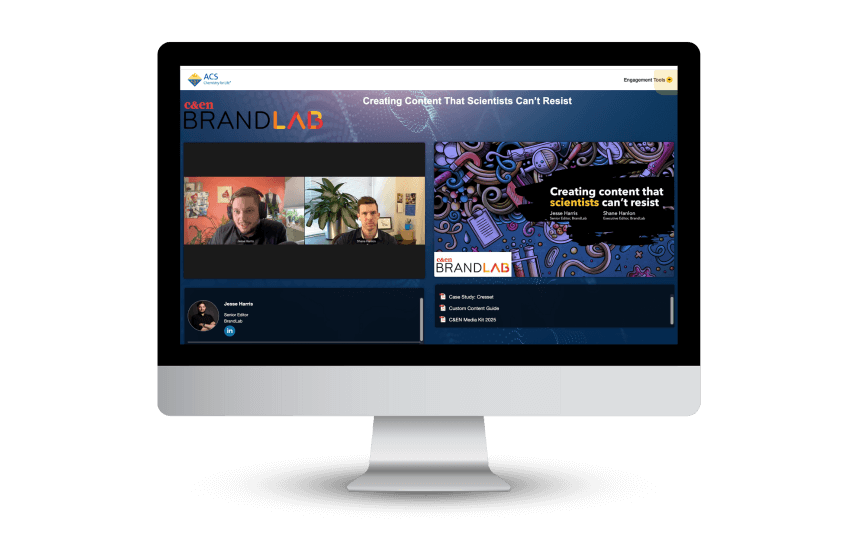
If you’re looking to go deeper into how to create science content that resonates with real scientists (beyond just choosing a good stock photo) the BrandLab team has an on‑demand webinar you might find helpful.
In Creating Content that Scientists Can Resist, two of our scientists turned content marketers unpack what makes technical storytelling credible, compelling, and trustworthy. You’ll learn how to translate complex research, elevate SME insights, and develop content that connects with your scientific audience.